This photograph album features photographs from the Fibrations Luncheon in 1983 and the Fibrations Conference in 1984. Includes photographs of guild members participating in events as well as a photograph tutorial on warping with Allen Fannin.
This scrapbook was compiled by Susan Stanley-Jones to document the Explorations Weaving Conference hosted by the Prince George Weavers and Spinners Guild in June of 1980. The conference showcased works from weavers from all around northern British Columbia. Includes photographs, wool swatches, handwritten descriptions, pamphlets, local advertisments, event items, and weaving patterns. Also includes a bookcover woven by Frankie Carpenter, a member of the Prince George Weavers and Spinners Guild.
This photograph album documents the Prince George Weavers and Spinners Guild members' participation in several events and galleries. Events scale include the Prince George Exhibition and the Northwest Weavers Conference. The album features newspaper clippings, programs, and 113 photographs within the 36-paged book.
This photograph album documents a Prince George Weavers and Spinners Guild gallery show from 1970 as well as some of the guild members. The album is 13 pages and is has 36 photographs.
This scrapbook documents projects, members, and activities of the Prince George Weavers and Spinners Guild between the years 1974-1976. The 30 page scrapbook features newspaper clippings, pamphlets, local advertisements, a type-written letter, and 47 photographs.
Consists of issues 1-37 of The Alexander Mackenzie Trail Association newsletter, 1985-1994. Missing issues no. 2, 11, 12, 14, and 25.
Consists of interviews were conducted by Rhys Alan Pugh in the summer of 1999 with Rainbow Lodge residents. Informed consent provided, but names are anonymous. Contains 2 boxes of audio recordings and 1 binder of transcripts.
This photocopied typescript memoir records memories, stories, and advice of Harry Weaver. Weaver was a trapper, hunter, and long-time resident of the Prince George and Upper Fraser areas. The manuscript includes some photocopied article excerpts from magazines and newspapers, as well as a photocopied photographs.
Weaver, Charles Henry "Harry"The John M. Holzworth Field Report consists of 24 descriptive text with 75 black and white photographs that document biological reconnaissance work undertaken by Holzworth, and includes detailed descriptions of the land and water transportation routes taken, weather observations, and commentary on communities and people he encountered while on his expedition to hunt and collect bighorn sheep and caribou specimens in the area. In order to reach the Peace River country via water route he travelled from Prince George to Summit Lake, Crooked River, and on the Parsnip River system and then down the Peace River, accompanied at one point with a trapper named George Wosly and stopping to hunt in the Mt Selwyn area. On the expedition which made its way into the headwaters of the Pine/Murray region to search for mountain sheep, Holzworth relied on two local guides, Harry Garbitt and Louis [last name unknown] to traverse the vast landscape. The report provides documentation also of members of the Beaver First Nation camps and images of early 20th century homesteaders near present day Tumbler Ridge. Finding no sheep in this area, Holzworth came out to Pouce Coupe, and returned back into the mountains from the Alberta side, up the Wapiti, where he was successful in getting his bighorn sheep specimens.
Item consists of a photocopy of the 1940 Prince George telephone directory. Includes names and addresses of Prince George residents and businesses.
Pamphlet includes photographs and promotional blurbs for Prince George District, Vanderhoof District, McBride District, Terrace District, Burns Lake District, Smithers District, and Prince Rupert. Also includes a "Lands Available" section.
Item is a photocopied pamphlet created by Agriculture Canada in celebration of its 100th anniversary.
Item consists of photocopied pages from the 1922 Wrigley's B.C. Directory. Includes Fort Fraser, Fort George, Fort St. James, Gibson's Landing, Giscome, Giscome Portage, Hutton Mills, Longworth, Loos, Penny, Prince George, Prince Rupert, South Bulkley, South Fort George, and South Francois Lake.
Ministry of Forests E.P. 886.13 was established by silviculture researcher Robert Brockley between 1992 and 1999, and consisted of 8 installations across the interior which shared the same experimental design. Five involved lodgepole pine and three involved interior spruce. Complete descriptions of the site characteristics, experimental treatments, and early results are given by:
Brockley, R.P. and D.G. Simpson. 2004. Effects of intensive fertilization on the foliar nutrition and growth of young lodgepole pine and spruce forests in the interior of British Columbia (E.P. 886.13): Establishment and progress report. Technical Report 018. B.C. Ministry of Forests., Research Branch, Victoria, B.C. http://www.for.gov.bc.ca/hfd/pubs/Docs/Tr/Tr018.htm
The key difference between E.P. 886.13 and other lodgepole pine fertilization studies in the BC interior was the inclusion of two treatments involving annual fertilizer applications; see Brockley and Simpson (2004) for full details.
Early tree responses to the fertilization treatments at two lodgepole pine installations, including Kenneth Creek, were presented in:
Amponsah, I.G., P. G. Comeau, R.P. Brockley, and V.J. 2005. Effects of repeated fertilization on needle longevity, foliar nutrition, effective leaf area index, and growth characteristics of lodgepole pine in interior British Columbia, Canada. Canadian Journal of Forest Research 35: 440 – 451. https://doi.org/10.1139/x04-200
Prior to his retirement, Brockley published a comprehensive report on the results of the lodgepole pine installations in this study:
Brockley, R.P. 2010. Effects of intensive fertilization on the foliar nutrition and growth of young lodgepole pine forests in the British Columbia Interior: 12-year results. Technical Report 058. B.C. Ministry of Forests and Range., Forest Science Program, Victoria, B.C. http://www.for.gov.bc.ca/hfd/pubs/Docs/Tr/Tr058
The Kenneth Creek installation, approximately 60 km ESE of Prince George, was established in 1993 in a 10-year-old lodgepole pine plantation. [Note that this site is also referred to as the "Bowron" site in some documents and filenames.] The site was located on a flat glacial outwash terrace with fairly uniform deep sandy soils, and was extensive enough that it later hosted one of two installations of E.P. 886.15 established in 2001. (See https://search.nbca.unbc.ca/index.php/2023-2-2-1-3.) The Kenneth Creek site was attacked by mountain pine beetle in 2006, resulting in at least 80% tree mortality. In 2013, the stand was levelled in order to enable replanting.
Dr. Paul Sanborn's involvement in this study addressed three aspects of soil and nutrient cycling responses to the fertilization treatments:
- mineral soil and forest floor nutrient stocks, (Sub-subseries 2023.2.2.15.1)
- litterfall amounts and chemical composition, and, (Sub-subseries 2023.2.2.15.2)
- litter decomposition. (Sub-subseries 2023.2.2.15.3)
This document describes the background, objectives and experimental design of Ministry of Forests EP 886.13; research sites are not identified.
This paper gives an overview of the experimental details and some preliminary results after recovery of the final set of litterbags.
This document includes the figures to accompany the manuscript by Sanborn and Brockley entitled "Litterfall in a lodgepole pine fertilization experiment, Sub-Boreal Spruce zone, central interior British Columbia", which was submitted to the Canadian Journal of Forest Research but not accepted.
Includes the following graphs:
- Annual lodgepole pine needle litterfall by treatment (May 1995 – May 1999)
- Annual total litterfall by treatment (May 1995 – May 1999)
- Understory biomass components in July 1999
Item is the manuscript by Sanborn and Brockley entitled "Litterfall in a lodgepole pine fertilization experiment, Sub-Boreal Spruce zone, central interior British Columbia", which was submitted to the Canadian Journal of Forest Research but not accepted.
This document describes in detail the field sampling and sample handling procedures as used in 1999 and 2005. It omits description of bulk density sampling as this was not repeated in 2005.
Item is a 2000 fax of pre-harvest data tables from timber cruise report, including net merchantable volumes and stems/ha for Topley LTSPS plots.
Item is a March 1999 draft report by Paul Sanborn which was the working document on which the Research Note was based.
Item is an unpublished pre-harvest timber cruise report documenting standing timber volumes and site productivity at the Skulow Lake LTSPS site. The author is unknown and the work is undated.
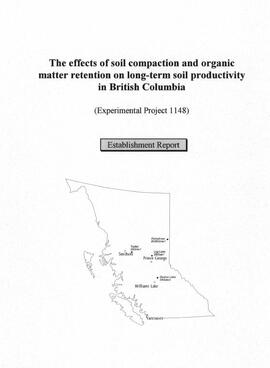
A spinoff study was conducted in the late 1990s by the Ministry of Forests research soil scientists responsible for the three LTSPS installations in the Sub-Boreal Spruce zone: Paul Sanborn (Log Lake, Prince George Forest Region), Marty Kranabetter (Topley, Prince Rupert Forest Region), and Bill Chapman (Skulow Lake, Cariboo Forest Region). The objective was to estimate the potential nutrient losses resulting from differing levels of woody biomass removal in the LTSPS treatments.
Final results were published in:
Sanborn, P., M. Kranabetter, and B. Chapman. 2000. Nutrient removals in woody biomass: preliminary estimates from the Sub-Boreal Spruce Long-Term Soil Productivity Study. LTSPS Research Note #LTSPS-04. Prince George, Prince Rupert, and Cariboo Forest Regions, B.C. Ministry of Forests. 6 p. https://www.for.gov.bc.ca/hfd/pubs/Docs/Ltsps/Rrn004.htm
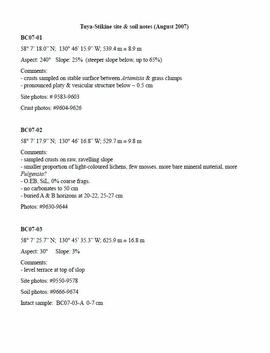
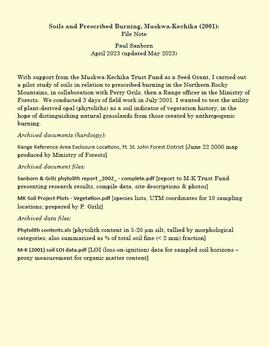
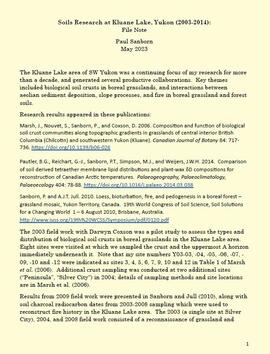
For this Northern Rockies pedological study, Dr. Paul Sanborn conducted field work jointly with researchers from the Ministry of Forests and Agriculture Canada from August 21-24, 2012, at two clusters of sites along the Alaska Highway west of Fort Nelson: near the Tetsa River crossing at km 585, and ~4.5 km west of Toad River at the "Poplars" campsite.
The focus of the study was on soils currently or recently containing permafrost as well as associated soils on nearby sites with warmer microclimates, with a total of 6 pedons described and sampled. One of these, an Organic Cryosol (pedon BC12-08), was documented in a short paper:
Sanborn, P., C. Bulmer, M. Geertsema, and S. Smith. 2022. A proposed Folic subgroup for the Organic Cryosols. Canadian Journal of Soil Science 102: 811–816. https://doi.org/10.1139/cjss-2021-0182
Associated soil microclimate monitoring occurred at this site, and is documented in:
Hasler A., Geertsema M., Foord V., Gruber S., Noetzli J. 2015. The influence of surface characteristics, topography and continentality on mountain permafrost in British Columbia. The Cryosphere 9: 1025–1038. https://doi.org/10.5194/tc-9-1025-2015
Some of the data from both papers was presented as a poster at the Canadian Society of Soil Science annual conference in 2013.
The highlights of the 2022 paper were presented at an online meeting of the Soil Classification Working Group of CSSS on January 20, 2023.
The sequence of site numbers is BC12-08, -09, (-10 was not used), -11, -12, -13, -14, and -15. Note that BC12-13 was described and sampled, but not photographed. An additional pedon designated as BC12-13A was located within ~10 m of BC12-13 on the same terrace, and had what appeared to be a buried fire-reddened layer under a possible buried Ah horizon. This pedon was photographed but not described or sampled.
Presentation slides for the January 2023 meeting of the Soil Classification Working Group, Canadian Society of Soil Science
Poster presentation at 2013 Canadian Society of Soil Science Conference
File contains a computer print-out of the Aleza Lake Research Forest Management Plan #1 for the years 1992 to 2002, which was prepared by Mike Jull.
Item is a photocopied 1939 article written by Norah Doherty for the Wolverhampton Express and Star, entitled "Gold Is Where You Find It". The legibility of this photocopy is poor; a transcription of the article follows.
Item is a photocopied article from the Prince George Citizen entitled "Old friends say thanks" about Norah Doherty.
Item is a photocopied article written by N.L. Doherty for S.T.U. Magazine, issue no. 2, published by the Wolverhampton & Staffordshire Technical College. The article, entitled "An Exile Returns", is a published letter written by Banbery.
Item is a photocopied letter from T.A. Warren, Director of Education, County Borough of Wolverhampton, North Street to N.L. Banbery, 62 Limes Road, Tettenhall, Wolverhampton, accepting Banbery's letter of resignation from the Technical School.
Item is a photocopied article written by Norah Doherty for "The Woolpack : The Magazine of the Wolverhampton Municipal Grammar School". The article is entitled "50 Years Ago at the Municipal Grammar School".